


Launching a new product is exciting, but with so many options available, how do you make sure your product stands out? The real challenge is not just getting noticed but creating real interest that leads to sales.
By using smart marketing strategies, you can spark interest in your new product and turn potential customers into loyal buyers. This is where demand generation comes in.
Demand generation is the process of creating awareness and interest in a company's products or services through targeted marketing strategies. It includes lead generation, content marketing, SEO, email campaigns, and nurturing prospects to convert them into customers.
Consider using demand generation tools to reach the right people, manage your campaigns, and track what works best.
Let's delve into the intricacies of demand generation to gain a comprehensive understanding of its significance and impact in the contemporary business landscape.
If you work in marketing, chances are you’ve heard these two terms used interchangeably, but they are not the same.
Demand generation and lead generation are two different marketing methods, and they take place at different stages of the sales funnel. Because they share similar characteristics, they’re often confused.
Although they may share similar qualities, the goals and deliberate tactics each method uses differ.
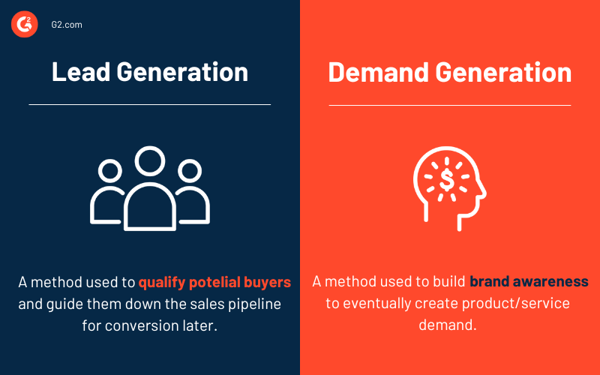
Another big difference between lead generation and demand generation is the type of content marketers create for each of these strategies. Because lead generation and demand generation happen at different stages of the buyer's journey, you'll want to utilize the correct marketing tactics for each strategy.
When your team uses demand generation, they’re focusing on the buyers. These potential buyers exist at the top of the funnel and may not even know they need your product or service. This is where your content comes in and educates them on why they need what you offer.
The key to creating content for your demand generation strategy is how you distribute it. At such an early stage in the sales pipeline, it's important to keep your content free. Potential customers will be drawn to free and useful content more than content that may be gated or sold for a price.
A strong demand generation strategy uses different content formats to engage prospects across the buyer’s journey before they’re ready to speak with sales. Here are the core content types grouped by function:
By offering it to them at no cost, you give them a valuable resource while simultaneously starting a brand-customer relationship. It builds trust and customer loyalty and gives them a reason to want to return.
This helps create multiple channels through which customers can interact with your brand and understand how your product can help them.
A good demand generation strategy has touch points along every stage of the buyer's journey. From the first-time visitor to your website to the customers you're looking to upsell during their next renewal, demand generation can strengthen relationships with prospective customers.
Here’s a snapshot of how a modern demand generation engine runs from start to finish
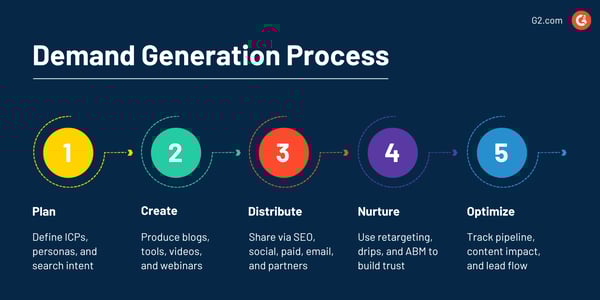
The following strategies should not be used in a silo. Play around with a different mix of each one and find the right combination that works for your business. Remember, your business is unique. Your demand generation efforts should be, too.
Understanding your customer needs is the first step in any successful marketing campaign. One easy thing you can do to start this process is to create a customer persona of your ideal consumer.
You can achieve this by focusing on audience demographics, psychographics, socioeconomic status, and brand affinity. Once you do that, consider the pain points your customer might face and build that into your customer profile. These will be your guiding light as you go about creating content.
Once you’ve figured out what your customer needs, you can turn to creating content that adds value for them.
A value-add is something extra your customer gets when they consume your content or do business with you. Even when you’re not trying to sell a customer, there’s still a level of salesmanship that should go into your content. Create an experience that provides extra value to your consumers.
The key to creating a great value-add is to give it away for free. Seriously. People are so used to filling out landing page forms and forking over their email that they might be deterred if you ask for those things too soon. Value-adds are about building authority and trust with your reader.
Example: If you’re writing an article about how to ask for a promotion, you could create a downloadable script that walks the reader through what they should say. This provides the reader with something free that other content doesn’t include.
If you’re looking to take your value-add to the next level, you should consider creating a free tool for your consumers. You’re probably familiar with free tools already. Whether it’s percentage calculators, URL shorteners, or hashtag generators, free tools are designed to get new users on your website.
Once they make it to your landing page, you can include links to other relevant resources and help guide them through your other content. Eventually, the goal is to have the consumers lead themselves through the sales journey and contact your company about your services.
Your free tool should always relate to the work your company does as a whole. You don’t want to create a free rent calculator if you sell pet accessories. Make it easy for the consumer to make the connection between your free tool and your paid services.
Sometimes, the best value-add can come from collaborating with other industry leaders.
If you’re struggling to reach your target audience, or maybe you want to tackle a project that seems too big to handle on your own, collaborating with other brands could be the perfect solution.
Collaborating with other brands will help you:
It can seem counterproductive to collaborate with someone you might see as a competitor. Instead, you should see this more as putting the customer first. Creating value by working with leaders in your industry can benefit the customer and help them make more informed decisions.
Plus, these collaborations are already happening. Would you rather reap the rewards or stay isolated?
You’ve heard it before: content is king.
But doing content the right way can be challenging. The companies that are seeing success are the ones that have invested in a comprehensive content marketing strategy. Content marketing is a specific type of marketing that prioritizes the creation, production, and distribution of original content.
Its primary focus isn’t to advertise the brand but to garner interest in a brand’s products or services, and it’s that distinction that makes content marketing a perfect addition to your demand generation strategy.
How can content marketing boost demand generation?
Some might argue that demand generation is impossible without content marketing. At the very least, it’s difficult to pull off without a dedicated content marketing plan.
The biggest mistake your company can make is assuming that demand generation is the job of a single department. Every team can benefit from demand generation, so every team should be involved.
As you build your demand generation strategy, loop in your sales reps and prep them with talking points. New leads might reach out to them after reading a piece of content on your blog, and your sales team will need to know how to receive their questions.
You should also involve your researchers to ensure the data you’re including in your content is fresh, relevant, and focused on user intent. Original data and research will help edge out the competition and give your customers that extra value-add.
Here’s a harsh truth: consumers don’t trust brands at face value.
What consumers lack in trust in brands, they make up for with trust in each other. Influencers and brand ambassadors are becoming the de facto authorities online about which brands to trust and which to ditch.
People trust other people more than they trust companies talking about themselves. Why? They think it’s more authentic and relatable.
Use this to your advantage by creating a brand ambassador program to activate your biggest fans. Don’t discount someone just because they aren’t on your payroll. Activate the influencers who really care about your brand and help them sing your praises.
The purpose of demand generation is brand awareness and, ultimately, converting strangers into customers. If you’re not already utilizing buyer intent data in your marketing strategy, you’re missing out on a huge opportunity to convert leads into sales.
Buyer intent data tracks the online activity of your consumers, both B2B and B2C, and allows you to see where along in the marketing or sales funnel they are. User intent data is powerful because it better informs you on how to keep customer attention, tells you how close they are to making a purchase, and whether or not they’re looking into your competitors as well.
Understanding those things can help you convert warm leads into sales or possibly even poach a competitor's client. Putting hard numbers behind your work will help increase sales and prove the return on investment (ROI) of your demand generation strategy.
Tracking the right metrics helps you prove impact and optimize your strategy. Here are the top KPIs for demand generation:
In B2B marketing, demand generation is more than lead acquisition. It’s a long-game strategy focused on building awareness, trust, and intent with decision-makers across complex buying journeys.
Rather than pushing for quick conversions, B2B demand gen nurtures prospects through a series of value-rich, intent-driven touchpoints, from the first blog post they read to the solution comparison they download before a sales call.
Here are the foundational strategies B2B teams rely on to build and sustain effective demand generation programs.
Content serves as the cornerstone of demand generation, initiating the creation of value-added resources and free tools, as discussed earlier. However, enhancing your demand generation efforts may necessitate the use of additional tools:
Managing all these demand-generation strategies simultaneously can be challenging without the right tools. Fortunately, demand generation is so popular that a variety of advanced software options are available to those who need them. If you’re looking for a cost-effective way to streamline the demand generation process, you’ll need the right tech stack.
Here are 3 tools you can use to optimize your demand generation strategy:
Marketing automation software is perfect for automating repetitive, time-consuming digital marketing tasks like triggering email marketing campaigns or scheduling social media posts. It saves your team time and frees them up to focus on more technical aspects of their job.
A key component of marketing automation tools is the included analytics features that allow users to measure the impact of an entire campaign across segments and channels. These features measure anything from key performance indicators (KPI), to campaign metrics and conversion rates for your biggest marketing campaigns.
This tool allows users to generate, manage, and publish content on their websites without the aid of developers. It's ideal for any team that doesn’t have a full-time developer on staff and for anyone looking to shorten the time needed from writing to publishing.
G2 helps businesses find the best marketing automation software to streamline campaign execution, personalize customer journeys, and drive scalable growth across channels.
*These are the five leading marketing automation software solutions from G2's Winter 2026 Grid® Report.It's not enough to generate demand; you must ensure the contacts you send to your sales team are worth their time. Lead scoring is a method used to determine the quality of a lead based on how likely they are to make a purchase.
Lead scoring software allows you to manage every stage of the lead generation process, from sales prospecting to lead nurturing and more. If you're working on a marketing team that manages demand generation and lead generation, lead scoring software can make tracking everything in one place easy.
G2 helps businesses find the best lead scoring software to identify high-intent prospects, prioritize sales outreach, and improve conversion rates with data-driven precision.
*These are the top 5 leadscoring software solutions from G2's Winter 2026 Grid® Report.
CRM software is probably one of the most important tools you’ll need for demand generation. Once you’ve moved your demand generation prospects into lead generation, you’ll need a place to collect and categorize their contact information.
CRM software will record interactions between your business, prospects, and existing customers. It’s also great for tracking prospects and contacts throughout the sales pipeline, facilitating an enhanced customer experience.
Having the right tools for the job can make or break your demand generation strategy. Exploring your options and choosing the right tech stack for your needs is crucial to success.
G2 helps businesses find the best CRM software to manage customer relationships, centralize communications, and drive pipeline efficiency from first touch to closed deal.
*These are the five leading CRM software solutions from G2's Winter 2026 Grid® Report.

Got more questions? We have the answers.
Gate content later in the buyer journey (e.g., case studies, pricing sheets). Early-stage content like blog posts, tools, and videos should remain ungated to maximize reach and engagement.
SEO ensures your content appears when buyers search for solutions, making it a core demand generation channel. In 2026, it’s also key to being cited in AI Overviews and LLM answers, driving brand visibility even without clicks. Optimize by using a clear structure, answering specific questions, and publishing original, authoritative content.
Intent data reveals the topics an account is researching. Use that intel to tailor outreach, recommend relevant content, or trigger targeted campaigns via automation.
Create shared definitions of MQLs and SQLs, run regular feedback loops, and co-own campaign planning and reporting, especially for ABM efforts.
Start with a documented strategy and reusable content formats. Then layer in automation tools, repurposing workflows, and AI to maintain consistency at scale.
The most effective demand generation strategies do more than spark awareness; they build sustained momentum across every stage of the buyer journey. When high-impact content, intent data, and the right tools work together, you create lasting interest, accelerate a qualified pipeline, and ensure your brand is present at every key decision point.
Learn more about how sales enablement can make selling easier and more effective.
This article was originally published in 2023. It has been updated with new information.


What is lead generation? Lead generation is the process of attracting potential customers for...
 by Kelly Fiorini
For any B2B business, lead generation and MQL conversions become a root cause of worry, so...
by Lauren Pope

What is the cost per lead? Cost per lead (CPL) is a straightforward marketing metric that...
 by Alyssa Towns