


When new leads enter your pipeline, the worst thing you can give sales reps is freedom without direction.
Without a clear plan, reps are left guessing when to reach out, which channel to use, and what to try next if the first touch falls flat.
Sales is a system, not a series of random actions. To consistently engage prospects and move deals forward, reps need structure, timing, repeatable outreach patterns, and a tool like CRM software to follow. That structure starts with a sales cadence.
A sales cadence is a structured sequence of touchpoints, such as emails, calls, and messages, used by sales teams to engage prospects over a defined period. Sales cadences improve lead follow-up, standardize outreach, and increase conversion rates by ensuring consistent and timely communication.
Think of a sales cadence as the tactical layer of your sales process. It outlines exactly what actions reps should take, when they should take them, and how each interaction builds toward a conversion.
In this guide, you’ll learn what makes an effective sales cadence, how to build one, and which best practices help sales teams turn more leads into customers.
While your business’s sales cadence includes touchpoints with prospects and customers, there are a few other elements you need to remember along the way as well: timing, contact frequency, the channels you use, your various audiences, and the content in those interactions.
Keep in mind that finding the right elements for your business might take some trial and error. What works for one company or sales cycle for a particular solution might be completely wrong for another. The only way to make the following four elements of a sales cadence work for your business is to remain consistent and always evaluate the process.
When creating a sales cadence schedule for your reps to follow, timing is everything. When thinking about timing, consider the day of the week and the time of day you reach out to the prospect.
Mondays usually consist of attending meetings and catching up on last week, and Fridays include winding down with simple last-minute tasks and heading out early. So you can count those two days out for prospecting. That leaves you with Tuesday, Wednesday, and Thursday.
Also, keep in mind that you don’t want to reach out to prospects at the beginning of the day, because they are likely mentally processing everything they have to get done. Stay away from lunchtime as well, since most people like to step away from their desks during breaks. Statistically speaking, the best time to reach out to a prospect is between 4-5 p.m.
Along the lines of timing, you should also remember to spread out your scheduled touchpoints. The last thing you want is for the prospect to think you’re spamming them with outreach. This is a recipe to be ignored. You don’t want to be written off by a prospect before you even have a chance to interact with them, but you also don’t want them to forget about you.
A general rule of thumb is to start with an email and then follow up with a phone call, leaving a voicemail if they don’t answer. From there, make sure to space out other touchpoints and incorporate a variety of outreach methods. Some prospects might not even pay attention to their LinkedIn messages because they are so consumed with answering emails. Approach them with a few different methods – without overwhelming them.
A typical sales cadence lasts between two and four weeks. If the relationship with the prospect isn’t going anywhere, don’t just lengthen the sales cadence. You want to ensure that every interaction offers fresh content from your end. It’s better to have a shorter cadence with quality information for the prospect than one that is redundant and longer just for the sake of it.
Whatever you do in terms of frequency, make sure you track each of your touchpoints in your CRM system. This way, as you move on to the next step in the cadence, you can easily find information regarding the last interaction and pick up right where you and the prospect left off.
Another important element of the sales cadence you follow is the channel you decide to use for each touchpoint with the prospect. Your sales cadence will likely include multiple channels for your reps to use.
Again, you won’t know which type of communication method your prospect prefers until they explicitly state it. Going at them from multiple channels might seem scattered, but it’s the only way to pick one to move forward with.
There are three main outreach communication methods in your sales cadence: email, phone, and social media.
Building a good sales cadence requires a deep understanding of the audience(s) you are targeting. If your business is new, small, and offers only one solution, it might require a single sales cadence to effectively sell to that one group of buyers. However, if you have multiple solutions and sell to businesses of all sizes, your target audiences might differ, requiring more than one sales cadence to suit each audience's preferences.
To create a proper sales cadence for each audience, research each audience to identify their pain points and the platforms on which they are most active. Once those are established, you can prioritize the groups based on how much value they can offer your business.
Quite arguably, the most important element of your sales cadence is the content you are distributing to your prospects throughout the sequence. The timing, frequency, and channels you use for your touchpoints could be planned to perfection, but if the actual content of the messages you are sending isn’t well-suited to your audience (your prospects), none of that matters.
Across the entire sales cadence, every single interaction and attempt at contacting a prospect you have needs to be focused on information regarding the value that your solution can offer them. Your conversations should include relevant research on the prospect and anything that can help you create a relationship with them.
However, if you ever get lost, returning to the value is never a bad place to steer the conversation back on track.
Once you’ve defined the elements of your sales cadence, building it is about turning those pieces into a clear, repeatable sequence your reps can follow.
If you’re looking to establish a sales cadence within your business's sales team, here's a solid example of what it might look like.
While not all sales cadences will look identical, the overall idea remains the same: to make consistent, sequential, and methodical touchpoints with prospects in the hopes of converting them into customers. A typical sales cadence lasts anywhere from 5 to 22 days.
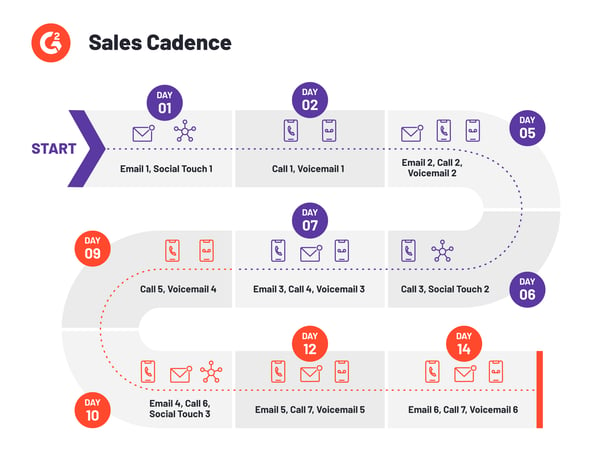
Your final draft might not exactly resemble this example. However, the first and last days will usually follow a similar pattern across businesses. Let’s examine those a little further.
On the first day, you’ll want to engage with the prospect on their social media and send them a cold email. Show them you’ve researched their business and that you have something of value to offer them. The next day, follow up that email with a phone call; if they don’t answer, leave a voicemail. Make sure the contents of that message reflect what you said in your initial email.
The next couple of touchpoints will likely vary, but on the last day of your sales cadence, if no relationship has been created, you will “break up” with the prospect. This will include your last email, phone call, or voicemail.
But don’t get too emotional.
The point of these messages is to wrap up your sales cadence, remind the prospect of a challenge their business is facing, and how your solution can come to the rescue if they give you the chance.
One last time, remind them of all the value they can revel in if they become a customer. Leave the door open for contact in the future, and let them know that you’d love to work with them at some other time. As for breakups, it should be pretty positive and upbeat.
Whatever you decide on for your business’s sales cadence, it should always include multiple channels of communication. You never know what the prospect prefers, and using the same method over and over is ineffective for everyone involved. Go at them from all angles with phone, email, and social media.
Second, you need to create a sense of urgency without being annoying. Allow at least one day to pass between each touchpoint, but never wait more than four.
And lastly, your sales cadence should be continually evaluated. Examining your cadence next to your pipeline will help you pick out which sales activities are converting customers and which ones are causing them to lose interest.
Below is another example of a sales cadence.
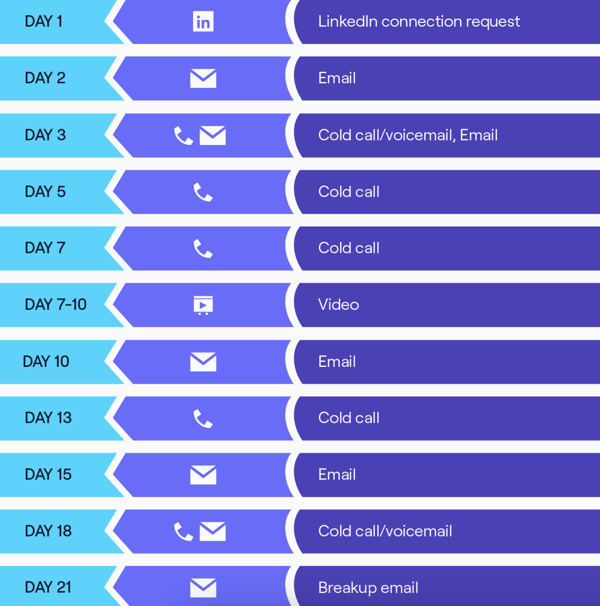 Source: Cognism
Businesses will implement a sales cadence to provide reps with structure. As the sales team becomes more familiar with their current cadence, they can identify inefficiencies and roadblocks they encounter.
Getting in touch with prospects is a huge challenge for reps, and going through the same process a few times and implementing new techniques can help them realize what’s working and where they tend to lose the most prospects.
It also enables reps to be more organized. By creating and offering a systemic framework, they can start their day knowing exactly which actions they need to take and for which prospects.
There is no more guessing what needs to be done and when. If a rep forgets where they left off with a prospect, they can retrace their steps back to the beginning of the sales cadence, see the last interaction, and move forward from there (another important reason to track each customer interaction in your CRM).
Implementing a sales cadence also makes it easier to train new reps as your business grows. You might be able to get away with not having a solid process in place with a few reps and minimal customers, but as your business starts to experience growth in employees and clients, you’ll need to be able to quickly train new reps.
Using a sales cadence will remove the stress of showing new salespeople your business's sales approach.
A strong cadence is one piece of a larger system. See how to automate your sales process end-to-end so cadences plug into lead routing, scoring, and pipeline updates automatically.
Follow the best practices below to create a sales cadence that drives engagement, increases conversions, and helps your sales reps close more deals.
Got more questions? We have the answers.
Sales leadership is typically responsible for designing sales cadences, while sales reps execute them. Managers should regularly review cadence performance and refine it based on conversion data and rep feedback.
Yes. Most sales teams use multiple sales cadences tailored to different buyer personas, deal sizes, products, or stages of the funnel. A single cadence rarely works for every scenario.
If a prospect doesn’t engage by the end of a cadence, they’re typically moved into a long-term nurture sequence or recycled back into the pipeline for future outreach, rather than pursued indefinitely.
Sales cadences should be reviewed regularly, often quarterly or alongside pipeline reviews, to identify drop-off points and opportunities for improvement based on performance data.
Yes. Most teams use CRM or sales engagement software to automate task reminders, email scheduling, and activity tracking, while still allowing reps to personalize outreach.
Sales cadences are most effective in B2B and high-consideration sales environments. However, cadence length, messaging, and channels should be adjusted to fit industry norms and buyer expectations.
While winging it can sometimes be an effective sales strategy, you don’t want reps to rely on that mentality. Offering a sales cadence shows the team what they can expect when attempting to get a prospect to convert into a customer.
There might be some offbeat conversations and interactions along the way, and that’s totally fine. Let them follow their instincts. However, as a leader, it’s your job to always provide that guiding light.
Ready to put your sales cadence into action? Explore the different types of CRM software and learn how to choose the right one for your team.
This article was originally published in 2020. It has been updated with new information.


Sales reps spend a surprising amount of time not selling.
by Harshita Tewari
There are plenty of business functions that support sales.
by Harshita Tewari
A lot happens behind the scenes of a sales department.
 by Mary Clare Novak