.png?width=400&height=150&name=Untitled%20design%20(56).png)


Ever wondered how the products you find on store shelves make their way from factories to your local supermarket?
It's not a magical journey; it's a complex process involving numerous intermediaries, one of which is wholesale.
Wholesale involves purchasing products in large quantities from manufacturers or distributors and reselling them at a markup to various business entities.
This collaborative approach benefits all parties involved. Manufacturers can focus on their core competencies—creating and developing products—while wholesalers handle the complexities of distribution.
However, the wholesale business is not without its challenges. Managing inventory, tracking orders, and ensuring timely deliveries can be daunting, especially for large-scale operations. This is where distribution ERP software comes into play. These powerful tools streamline the wholesale process, providing businesses with the visibility and control they need to thrive in a competitive market.
The wholesale process involves three main players: the manufacturer, the wholesaler, and the retailer. All three are essential in making, distributing, and selling goods.
In the wholesale process, the manufacturer starts our whole saga by creating something to sell. A manufacturer begins with raw materials and uses employees and machinery to work through the supply chain to build a finished product.
Say we’re selling cauliflower, one of my favorite vegetables. The manufacturer is the gardener. They till the soil, nurture the sprouts and harvest the final veggie. They then collaborate with a wholesaler who takes on the distribution responsibilities.
A wholesaler is an intermediary who distributes products in bulk from manufacturers to retailers. Buying in bulk allows them to purchase the products at a discount and resell them to retailers at a higher price.
In my cauliflower analogy, the wholesaler is the one who picks up the cauliflowers and loads them in a truck to transport them to the retailers. They also take the responsibility of scoping out grocery stores that may be interested in the product and getting those products to them.
In wholesaling, the retailer purchases a specific quantity of a product from a wholesaler and sells it to their customers.
In the cauliflower wholesale lifecycle, the retailer is the grocery store. Employees receive the cauliflower from the wholesaler and put it on display for the end-user to buy. The end-user is a customer like me who buys the cauliflower and roasts it for dinner at least once a week.
The retailer has the tough challenge of getting the customer to want the product. If it’s about me and cauliflower, this is easy. But for other products and industries, retailers have to understand the target audience and purchase wholesale goods they know they can sell.
A wholesale price is the amount at which manufacturers or distributors sell goods to retailers rather than directly to consumers.
This price is generally lower than the retail price because retailers purchase in bulk, reducing per-unit costs through economies of scale and saving on packaging and shipping.
Wholesalers also minimize costs by cutting out intermediaries and bypassing the marketing and customer service expenses that retailers face.
Wholesale pricing reflects these cost efficiencies, allowing businesses in the supply chain to profit while keeping retail prices competitive.
A wholesale electronics distributor offers Bluetooth speakers at a wholesale price of $45 per unit to a retailer specializing in tech gadgets. The retailer then sells these speakers to customers at $65 per unit, making a $20 profit on each speaker sold. This price difference allows the retailer to cover its own costs, such as marketing and customer service, while still earning a margin on each sale.
Wholesalers serve as essential intermediaries in the supply chain, enhancing efficiency and facilitating the flow of goods from manufacturers to retailers.
They break bulk by purchasing products in large quantities and selling them in smaller amounts, allowing retailers to order only what they need. This reduces excess stock and storage costs while providing a diverse selection of products from various manufacturers.
Additionally, wholesalers maintain significant inventories to act as buffers between manufacturers and retailers, ensuring products are readily available even during demand fluctuations. By absorbing the risk of stockouts, they help stabilize the supply chain.
In terms of distribution and logistics, wholesalers often have established networks that enable efficient product delivery to retailers. They consolidate orders from multiple retailers, optimizing transportation routes and reducing shipping costs.
Their deep understanding of market trends and consumer preferences allows them to provide valuable insights to both manufacturers and retailers, aiding in demand forecasting and production adjustments.
Furthermore, wholesalers offer financial support through credit terms, enabling retailers to purchase products without immediate payment. This support is especially beneficial for smaller retailers with limited resources, further enhancing overall supply chain management.
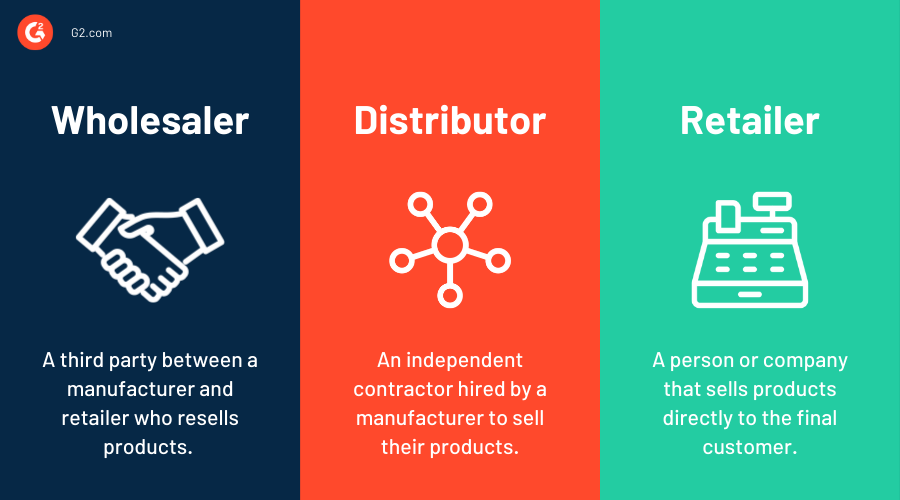
Wholesalers, distributors, and retailers are three positions that work closely together in the commerce space. Some may not find it very clear how these roles differ, so let’s examine them.
A wholesaler works as a connection between a manufacturer and a retailer. They can participate in the reselling of multiple products within various industries.
A distributor is an independent contractor hired by a manufacturer to sell their products to a wholesaler or retailer. Unlike a common wholesaler, a distributor works within tight boundaries of their industry and cannot sell competing products. A wholesaler who chooses to stick to one particular industry and avoid competing products could be referred to as a type of distributor.
A retailer is a person or company that sells products directly to the end-user. They purchase their goods from a manufacturer or wholesaler and mark up the prices to increase their profit margin. They can purchase products in bulk or in smaller quantities depending on their target audience’s needs.
Wholesalers, distributors, and retailers cross paths more than you might think. In fact, in many cases, companies could act as more than one at a time. If a manufacturer chooses to become a sales and distribution manufacturer, they may even be considered all three.
Lorem ipsum dolor sit amet, consectetur adipiscing elit. In molestie dolor lacinia sem ultrices fringilla. Donec neque ipsum, tincidunt non tristique sed, imperdiet et nisi
There are three wholesalers that conduct business in the wholesale market. The three are very different, and companies should take extra care when deciding which wholesaler they’d like to be or work with.
Merchant wholesalers are probably what you think of when you hear the word “wholesaler.” Merchant wholesalers simply focus on purchasing, storing, and reselling wholesale products they get straight from the manufacturer.
They prefer to buy in bulk and take over the entire selling approach. Once the manufacturer hands over the product, they bear the burden of all responsibilities and are on their own in the resale process.
Agents and brokers are different types of wholesalers who are less hands-on. Instead of purchasing the product and reselling it themselves, they act as representatives of the manufacturer.
They do this by leading negotiations and contractual conversations with the retailer on behalf of the manufacturer. They never take any ownership over the product and simply represent them in communications.
Sales and distribution manufacturers are distributors that wholesale their own products. Basically, if a manufacturer prefers to wholesale their own products but wishes to have the wholesaling process separate from production, they may create a wholesale branch within their company.
It’s a bit confusing but beneficial for those who want control over their distribution process but want it to live as its own entity.
It’s common for sellers to confuse wholesale and dropshipping because they both involve buying in bulk and reselling and are both very popular product sourcing and distribution methods. Learning the difference is essential to determine which makes the most sense for your business model.

Wholesale is the process of selling goods, generally in large quantities, to retailers who then distribute them onward to the end-user. Wholesale buyers purchase products from the manufacturer at a lower price and sell them to retailers at a higher price.
Dropshipping is a popular way to start an online business because it allows companies to sell products without carrying any inventory. With drop shipping, retailers require customers to place an order directly with their supplier, who then ships the product to the buyer. With this method, sellers don’t have to purchase and store products themselves.
Companies use drop shipping software to connect with drop shippers, utilize e-commerce solutions, provide order tracking capabilities to customers, and adjust pricing along the way.
Dropshipping and wholesale differ primarily in how much the manufacturer is involved in the order fulfillment process. A considerable advantage of dropshipping is that the seller doesn’t need to worry about inventory space. Managing inventory and stock can be highly tedious, and that whole process is on you when wholesaling a product.
Because no inventory needs to be held, companies that participate in dropshipping also don’t need to pay for products in advance. Products are created as they are ordered.
However, dropshipping isn't always a walk in the park. Because dropshipping goes straight from manufacturer to customer, there’s no third party to quality check the items before they get to the end-user. Companies may find wholesaling more favorable if they wish to keep a closer eye on the products being delivered and ensure high quality every time.
There are many benefits to adding wholesale to your business process. If done correctly, wholesaling can save a lot of people a lot of time and money.
What goes up must come down. What seems easy can become difficult. Although the benefits are great for wholesaling, there are a few challenges that a company can face at any stage of the process.
Did I do it? Did I convince you to start a wholesale business? Wow, I’m good.
Starting a wholesale business isn’t too difficult, but it definitely involves some preparation. Follow the steps below to get moving.
Companies should keep a few things in mind whether they choose to enter the wholesale business as manufacturers, retailers, or wholesalers.
No one ever said selling a product was easy, but I wonder if they tried wholesale.
From a manufacturer's perspective, wholesaling saves time, resources, and money. You go from being a one-person band to relying on a qualified intermediary to distribute for you. As a wholesaler, you get to work with knowledgeable creators and bridge the gap between them and the retailer.
Retailers are waiting to sell your product. Wholesalers are waiting to distribute them for you. The ball is in your court.
Learn about obstacles companies face when integrating AI and analytics into their supply chains.
This article was originally written in 2022 by Alexandra Vazquez. It has been updated with new information.
.png)

Millions in profits. Thousands of products. Zero inventory.
 by Brittany K. King
I sell, therefore I am...
 by Madeleine Marshall

Modern consumers have high expectations.
by Brittany K. King