

Because tone is highly contextual, automated systems can mislabel text without deeper contextual understanding, leading to inaccurate sentiment scoring.
Sentiment analysis, also called opinion mining, is an AI technique that identifies and classifies text as positive, negative, or neutral based on expressed opinions or emotions. It uses natural language processing (NLP), natural language understanding (NLU), and machine learning to analyze tone, intent, and subjective meaning in written content.
Sentiment analysis turns unstructured customer feedback into actionable insights by detecting tone, emotion, and intent in text. It includes multiple analysis types, delivers benefits like improved customer experience and brand monitoring, addresses challenges such as sarcasm and data bias, and supports use cases across customer feedback analysis, reputation management, and social media monitoring.
The main types of sentiment analysis include fine-grained sentiment analysis, emotion detection, aspect-based sentiment analysis, and intent analysis. Each type helps organizations analyze content at different levels, from overall tone to specific customer motivations.
Sentiment analysis helps businesses improve customer experience, strengthen relationships, and protect their brand reputation by analyzing customer opinions, feedback, and emotions at scale.
Sentiment analysis enables companies to quickly identify customer complaints, negative feedback, and recurring issues across reviews, surveys, social media, and support tickets.
By analyzing this data, teams can:
This proactive approach leads to higher customer satisfaction and stronger retention.
Also known as opinion mining, sentiment analysis provides insights into customer emotions, preferences, and behavior patterns.
Businesses can use these insights to:
By understanding how customers truly feel, companies can build more meaningful and data-driven relationships.
Sentiment analysis plays a critical role in protecting brand reputation. It allows businesses to monitor public sentiment across social media, news outlets, and online platforms in real time.
This helps organizations:
Early detection of sentiment shifts enables companies to act quickly and prevent potential public relations crises.
Sentiment analysis faces challenges in accurately interpreting context, tone, neutrality, authenticity, data quality, and potential algorithmic bias in text data, which can impact the reliability of sentiment scores.
Sentiment analysis models typically classify text as positive, negative, or neutral. While strong positive or negative statements are easier to detect, neutral or mixed sentiments can be more difficult to categorize accurately.
Challenges include:
This complexity can lead to oversimplified scoring or misclassification of nuanced feedback.
Sentiment analysis tools often struggle to accurately interpret tone, especially when text includes sarcasm, irony, humor, or cultural nuances.
While natural language processing (NLP) models can detect keywords and patterns, they may miss the intended meaning behind certain phrases.
Challenges include:
Because tone is highly contextual, automated systems can mislabel text without deeper contextual understanding, leading to inaccurate sentiment scoring.
Sentiment analysis tools typically evaluate text without verifying its authenticity. As a result, they may struggle to distinguish between genuine customer feedback and fake or bot-generated reviews.
This can create issues such as:
Without additional fraud detection systems, fabricated content can distort sentiment analysis results.
For the most effective results, businesses must develop a sentiment analysis process that fits their unique needs, but some steps can help every team get started.
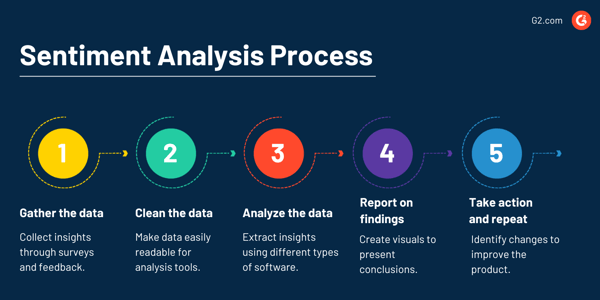
The first step is identifying and collecting relevant customer data. This may include:
Businesses should determine which data sources align with their goals. Social media monitoring is especially valuable for capturing real-time customer sentiment and public perception.
Raw text data must be cleaned before analysis to improve accuracy. Data preprocessing typically includes:
Clean data ensures sentiment analysis tools can accurately interpret the content.
Once prepared, the data is analyzed using sentiment analysis tools and techniques such as:
The type of analysis depends on business objectives. Teams may measure overall sentiment (positive, negative, neutral), track trends over time, or evaluate sentiment by product, feature, or customer segment.
After analysis, results should be translated into clear, actionable insights. This often includes:
Clear reporting helps leadership, analysts, and the organization’s knowledge architect understand customer sentiment, compare results and make informed decisions.
Sentiment analysis is most valuable when it drives action. Businesses should:
Because customer opinions evolve, sentiment analysis should be an ongoing, iterative process to continuously improve customer experience and satisfaction.
Sentiment analysis is used to monitor customer feedback, improve products and services, protect brand reputation, enhance marketing strategies, and support data-driven business decisions.
Businesses use sentiment analysis to evaluate customer reviews, surveys, and support interactions.
Common applications include:
This helps teams prioritize improvements based on real customer sentiment.
Sentiment analysis enables organizations to track how their brand is perceived across social media, news platforms, and online communities.
Use cases include:
This proactive monitoring protects brand image and public trust.
Companies analyze social media conversations to understand audience sentiment and engagement trends.
This supports:
Social listening combined with sentiment analysis provides actionable marketing insights that feed directly into broader performance benchmarking strategies.
Below are answers to common questions.
Yes, ChatGPT can perform sentiment analysis by classifying text as positive, negative, or neutral and identifying tone or emotion. It uses natural language processing (NLP) techniques to interpret context, intent, and subjective language in written content.
ChatGPT can analyze customer reviews, social media posts, survey responses, and support messages. However, for large-scale or production use, businesses typically rely on specialized sentiment analysis models or APIs.
An example of sentiment analysis is analyzing customer reviews to determine whether feedback is positive, negative, or neutral. For instance, the sentence “The product works well, but customer service was slow” may be classified as mixed sentiment.
Businesses use this approach to evaluate brand perception, product satisfaction, and customer experience trends.
Natural language processing (NLP) is used in sentiment analysis to interpret text, detect tone, and classify opinions. NLP techniques such as tokenization, part-of-speech tagging, and machine learning models help systems understand context and linguistic patterns.
Advanced methods may use natural language understanding (NLU) and deep learning to detect sarcasm, intensity, and nuanced emotional signals.
The best model for sentiment analysis depends on the use case, dataset size, and required accuracy. Traditional machine learning models like logistic regression work for basic tasks, while transformer-based models such as BERT or GPT variants provide higher accuracy for complex language.
For high-stakes use cases such as brand risk monitoring or compliance, some organizations pair advanced models with human-in-the-loop review to ensure accuracy and accountability.
Social media monitoring is a great way to gather feedback and get a pulse of customer sentiments.


Last updated: August 5, 2026 What is natural language understanding (NLU)? Natural language...
 by Shreesh Singh

What is lemmatization? Lemmatization is a technique used in linguistics and natural language...
by Alyssa Towns

There’s a good chance you process information so quickly in conversation that your brain...
by Alyssa Towns