What is a content delivery network?
A content delivery network (CDN) is a network of servers distributed across the globe that work together to deliver content to users more efficiently and quickly. The CDN works by caching and storing copies of a website's static content, such as images, videos, scripts, and other files, on servers distributed worldwide.
When a user requests content from the website, the CDN selects the server closest to the user and delivers the content from there, reducing the distance the data must travel and improving the user experience. CDNs can also help reduce the load on the website's origin server, improving its performance and reliability. CDNs are crucial in delivering fast and reliable web content to users worldwide.
Many organizations use content delivery network (CDN) software to improve website performance and ensure efficient content delivery.
Types of content delivery networks
There are several types of content delivery networks, each with unique features and benefits. The choice of CDN type will depend on the specific needs and requirements of the website or application.
- Traditional CDNs use geographically distributed servers to deliver website content. Traditional CDNs are suitable for many website types and can help improve website reliability.
- Peer-to-peer CDNs use a distributed network of devices to cache and deliver website content rather than relying on dedicated servers. This approach can be more cost-effective and scalable than traditional CDNs, as it leverages the computing power of user devices. However, it may not be as reliable or performant as traditional CDNs.
- Dynamic site acceleration (DSA) CDNs use advanced caching and optimization techniques to accelerate the delivery of dynamic website content, such as personalized or user-generated content. It’s ideal for websites with a lot of dynamic content.
- Video streaming CDNs are designed to deliver high-quality video content, such as live streams or on-demand videos. These CDNs use specialized video delivery protocols to ensure smooth and reliable video playback, even for viewers with slower internet connections.
- Hybrid CDNs combine two or more CDN types to offer a more customized solution. For example, a website might use a traditional CDN for static content and a DSA CDN for dynamic content to optimize website performance and user experience.
Benefits of a content delivery network
Regardless of a user's location, CDNs were designed to provide online data in a short amount of time. This is accomplished by copying digital content and putting it on delivery servers at key physical places spread out over a wide area. Below are some of the common benefits of using a CDN.
- Improved website performance: By caching and delivering content from servers closer to the user, CDNs can significantly reduce page load times, leading to a better user experience.
- Higher availability and reliability: CDNs distribute website content across multiple servers, which means that if one server fails or goes down, the CDN can automatically redirect traffic to another available server, ensuring that the website remains accessible.
- Reduced bandwidth costs: Since CDNs can offload much of the traffic from the website's origin server, they can significantly reduce the bandwidth the website consumes, leading to lower hosting costs.
- Better scalability: As website traffic increases, CDNs can dynamically scale their resources to handle the load, ensuring that the website remains fast and available even during peak traffic.
- Improved security: Many CDNs offer additional security features, such as DDoS protection, web application firewalls, and SSL/TLS encryption, which can help protect websites from attacks and other security threats.
Content delivery network best practices
By following the right practices, users can ensure their CDN is optimized for performance, reliability, and security.
- Optimize website content: Before implementing a CDN, ensure the user's website content is optimized for fast delivery. It includes minimizing image sizes and other files, reducing the number of HTTP requests, and using a content delivery strategy suitable for the website.
- Choose the right CDN: Select a CDN optimized for specific needs and use cases. Consider server locations, delivery methods, security features, and pricing.
- Implement SSL/TLS encryption: Use SSL or TLS encryption secure all communications between the CDN and the user's browser. It helps to prevent unauthorized access to sensitive data and improve user trust.
- Monitor performance: Regularly monitor the performance of CDN to ensure that it delivers content quickly and reliably. Use web analytics and monitoring software to track page load times, server response times, and other key metrics.
- Optimize cache: Adjust cache settings to ensure content is stored appropriately and delivered from the closest available server. Consider using a caching strategy that balances freshness and latency to optimize the user experience.
- Use multiple CDNs: Consider using multiple CDNs to improve reliability and availability. Distributing content across multiple CDNs can minimize the risk of downtime or service interruptions.
- Monitor security: Regularly monitor CDN for security threats and vulnerabilities. Use tools such as intrusion detection systems and vulnerability scanners to identify and address potential security risks.
Content delivery network vs. cloud computing
Confusing a content delivery network with standard cloud computing is common, but the two differ.
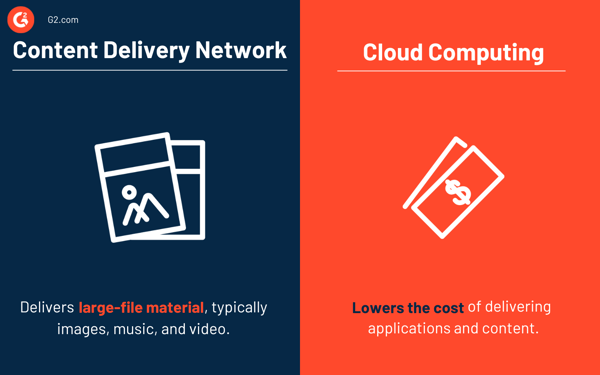
The main purpose of a content delivery network (CDN) is to deliver large-file material, which is mainly static images, music, and video. However, streaming media is also becoming prevalent on CDNs.
By utilizing computer resources that would otherwise go unused, cloud computing is a developing technology technique that can lower the cost of delivering applications and content. Even when they provide material and apps to a few users, most computers idle most of the time. With the help of server virtualization, many virtual machines (VMs) can share a single host's resources (CPU, memory, and storage), each running its programs and providing content.
Learn more about cloud computing and how it delivers shared resources.




 by Amal Joby