What is security management?
Security management safeguards an organization’s assets against threats. It secures physical facilities, IT necessities, employees, and other organizational requirements.
Identifying and documenting assets while implementing comprehensive policies and processes are security management’s primary objectives. Protecting organizational assets against threats ensures their integrity, confidentiality, and availability.
Security management covers cloud security as a part of its overall strategy. Many security management programs implement cloud access security broker (CASB) software to adopt a protection layer and enforce policies regarding employee access to the cloud.
Types of security management
Various specialized domains come from security management. They address the domain-specific aspects of safeguarding a company against threats.
- Information security management (ISM) comprises data encryption, access controls, classification, and audits. It protects intellectual property and prevents unauthorized access, disclosure, or destruction.
- Network security management takes care of an organization’s network infrastructure from cyber attacks, maintaining confidentiality and data integrity. It sets up firewalls, intrusion detection and prevention systems, and security protocols.
- Cybersecurity management protects the entire IT ecosystem. It includes defensive and sometimes offensive strategies against various threats. Incident planning and response fall within its purview, along with continuous monitoring of the digital environment.
Types of risks in security management
Security management mitigates diverse threats faced by an organization. These digital risks are grouped into two categories.
- External risks originate from outside an organization. Regulatory or supply risks like strategic competition, customer demand, operational disruptions, or financial risks like currency fluctuations, natural disasters, and cyber attacks are some common examples.
- Internal risks originate and impact the organization from within. These may include strategic concerns, operational errors, financial issues, or safety hazards.
Benefits of security management
Robust security management systems stop an organization’s assets from being compromised in any adverse situation. It offers multiple other benefits.
- Data protection safeguards sensitive data and ensures effective data governance.
- Regulatory compliance establishes adherence to industry-specific compliance requirements. Non-compliance often carries substantial fines.
- Cost optimization empowers organizations to prioritize high-risk assets, preventing unwanted expenditures in security measures or monetary loss due to downtime.
- Security culture educates employees across the entire organization about security best practices. It fosters an enterprise-wide that focuses on security.
- Adaptation to new threats equips organizations with the means to detect and contain threats that aren’t so common. It helps to adjust to the ever-evolving security landscape.
Security management phases
There are three fundamental phases: assessment, awareness, and activation.
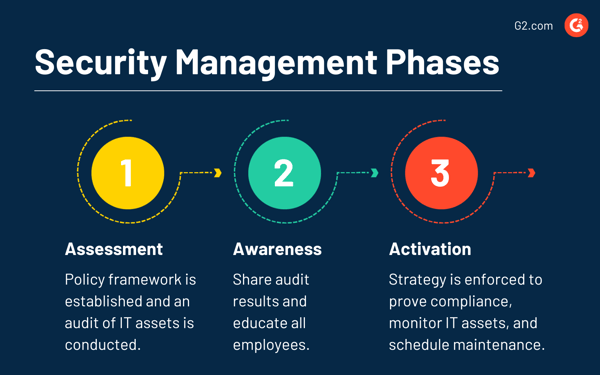
Here’s what they mean:
- Assessment. Security leaders establish a policy framework for their IT infrastructure. Their team performs an in-depth audit of IT assets according to compliance requirements. Vulnerabilities and gaps in existing IT infrastructure come up in this stage.
- Awareness. Security professionals share audit results and educate all the employees, including the IT team. It covers all basics, from cybersecurity best practices to roles and responsibilities with third-party vendors.
- Activation. IT teams enforce the security strategy to prove compliance, monitor IT assets, and schedule routine maintenance. It also includes ongoing revisions to adapt to new business needs, technologies, or threats.
Best practices of security management
The International Organization for Standardization (ISO) and the International Electrotechnical Commission (IEC) suggest a few best practices to implement security management. Professionals can find it in ISO/IEC 27001. Here’s a brief overview:
- Understand business needs. Before implementing security management, know the organization’s operations, tools, and current security systems comprehensively.
- Establish a security policy. Draft a clear and comprehensive information security policy before implementation.
- Monitor data access. Monitor data access. Supervise who accesses data and related information, ensuring only authorized individuals and properly configured device enrollment systems gain access.
- Conduct security awareness training. Educate employees about common vulnerabilities and remediation techniques.
- Secure data. Prevent unauthorized access and guarantee security by encrypting and backing up all organizational data.
- Conduct internal security audits. Identify and fix security vulnerabilities in the internal security infrastructure before implementing security management.
Information security management vs. cybersecurity
While information security management and cybersecurity share commonalities and often overlap, they have a distinct scope. Information security management comprises securing physical premises, facilities, and equipment, not just digital assets. It protects the confidentiality, integrity, and availability of an organization's intellectual property, trade secrets, and other proprietary information.
Cybersecurity focuses on securing electronic systems, networks, and connected devices against cyber threats like malware and malicious hacking. It emphasizes protecting digital data while preventing risks associated with cyber threats, which can disrupt operations and compromise an organization’s security posture.
Both are equally important for an organization’s security. They ensure data and assets are safe and vulnerabilities are identified and remediated before attackers can exploit them.
Learn more about how to manage vulnerabilities and reduce security risks to your organizations.