
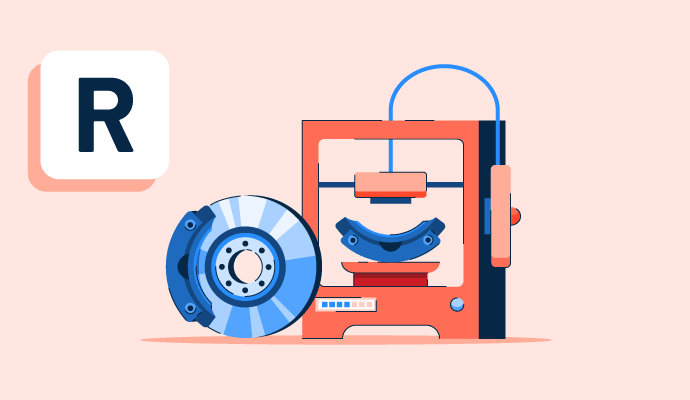
Rapid prototyping is a product development approach to building a quick and affordable physical representation of a concept or idea. The primary objective is to test and improve before moving forward with more expensive and time-consuming manufacturing procedures.
With rapid prototyping, a virtual model is typically created using computer-aided design (CAD) software and turned into a physical prototype using a 3D printer or another prototyping software. Designers and engineers use rapid prototyping to easily alter the design in response to testing results and user feedback.
Rapid prototyping is valuable for exploring and testing different ideas and concepts. It tests a product's usability and functionality in a more realistic setting. Rapid prototyping is of two types, namely:
Rapid prototyping offers many benefits to streamline the product development process to help achieve a better result. Below are some popular rapid prototyping benefits:
Many rapid prototyping technologies are available, each with unique strengths and limitations. Here are some common types of rapid prototyping:
The rapid prototyping process can be repeated multiple times throughout the product development cycle to refine the design. This will help ensure the final product meets the desired specifications and requirements.
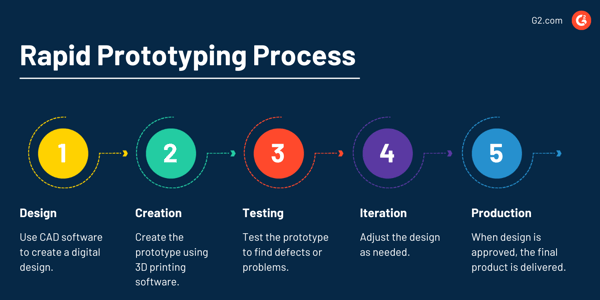
A rapid prototyping process typically involves the following steps:
Businesses have used traditional prototyping for years to conceive, design, and produce precise models of diverse items. This technique needs years of expertise and hours of labor. A simple blueprint can temporarily prototype sophisticated components using equipment like CAD software, competent machinists, or pen and paper. Machinists can swiftly construct a full or partial model with thorough scrutiny and this technique.
Rapid prototyping takes a new method of making 3D models and components over traditional prototyping. The materials are milled on a CNC machine and created using business software with 3D printing stereolithography. It’s the more complicated of the two prototyping alternatives since it may produce nearly similar prototypes rather than the more basic mockup that comes with traditional prototyping.
Before a product is sent to production, rapid prototyping aids in visualizing digitally rendered designs. Additionally, it’s a fantastic way to test concepts and design ideas faster and more efficiently.
Learn more about 3D printing and discover how to construct three-dimensional objects layer by layer.


What is GDPR? General Data Protection Regulation, or GDPR, unifies data privacy laws across...
by Sagar Joshi
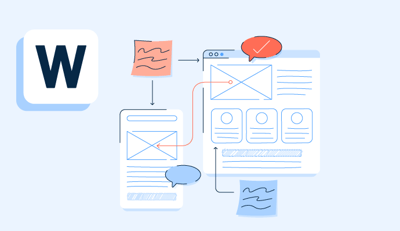
Last updated: August 10, 2026 What is a wireframe? A wireframe is a simple visual blueprint...
by Sagar Joshi

What is background subtraction? Background subtraction is a technique widely used in video...
by Sagar Joshi