What is a product catalog?
A product catalog is a means through which a product or a brand communicates with its customers. Customers are informed of all relevant product details before they move ahead in the purchase funnel. For a business, it's a tool that helps its product or services go online and become visible to potential customers. More visibility means increased sales prospects which in return assures better conversion rates.
With an increase in internet penetration rate, retailers operating in brick-and-mortar models are making a move to online platforms. Retailers with a significant online presence are attempting to mimic the traditional in-store experience within their e-commerce platform. While the transition from offline to online looks highly relevant, managing large amounts of product data, keeping it updated, and sending it across multiple channels could be a real struggle for any online retailer.
However, tools like catalog management software help design product catalogs that consolidate all relevant information in one place and enable merchants to make timely updates with accurate information. Buyers also get the benefits of directly accessing product details on the catalog page without getting lost on the platform.
Catalog management can be used by any business having a set of products or services to sell over their own e-commerce website or via any marketplace.
Benefits of using a product catalog
Product catalogs present an opportunity for businesses to reach new shoppers, grow the customer base, and increase sales. Apart from creating a flawless user experience, these collections of product information offer multiple benefits that drive internal processes and external purchase decisions.
- Consolidating product information: Product catalogs enable the consolidation of all details that are useful to showcase to the customers. For better engagement, customers must have all the information related to the product that helps drive purchase decisions, such as features, images, prices, reviews, user guides, etc. It also helps customers get a visual feel of the product from multiple dimensions. A well-designed catalog always boosts confidence in the purchase decision, which is a positive metric for any retailer.
- Contribute to sales effort: It is also an excellent tool in the sales process because a product catalog can be distributed among the existing marketing and sales channel to build brand awareness and increase the customer base. It also helps the sales team communicate information to clients or customers during a sales call or product demonstration. It helps save valuable time by making information easily accessible.
- Improve user experience: Well-designed product catalogs reflect the company’s brand and create a unique user experience, which helps with brand awareness. With consistent and updated information across product categories, it moves customers one step closer to a purchase. It is essential to anticipate customers' needs and create catalogs that enhance the desire of visiting the online store again.
Basic elements of a product catalog
Although product catalogs may vary based on the company and its solutions, there are several basic elements that should exist in all versions:
- Product name: It is essential to assign a distinct name to each product to help customers differentiate.
- Product description: This element contains detailed information about a product such as weight, dimension, specification, and so on.
- Visuals: Visuals or pictures are an important element of a product catalog. Eye-catching visuals always boost customer confidence and build trust.
- Features: Features include the most important key points that build knowledge on the product and explain what makes it unique among the competitors.
- Pricing: Correct pricing ensures buyer’s trust and it should be represented in local currency that matches the buyer’s location.
- Discounts: If the company has offered any seasonal discounts or coupons, it should be displayed in the catalog.
- Call to action: Call to action buttons help the target audience to take necessary action on how to buy the product or make further inquiries.
- Certification: Certification ensures the list of certifications earned by the product such as International Organisation for Standardisation (ISO) certification.
- Usage guide: A user guide or manual to use the product is an essential element, and if it requires safety measures, the catalog must inform and educate customers.
- Warranty or guarantee: It specifies the product’s warranty or guarantee clauses and returns policy.
- Terms and conditions: It includes company terms and conditions of using the product and possible disclaimers to maintain transparency with customers.
Product catalog best practices
In order to make a product catalog work, companies must follow these best practices:
- Selection of products: It's important to decide which product to include in thecatalog keeping in mind the category they belong to. Specifying the right solutions under the right category product catalogs saves customers a significant amount of time and leaves no space for confusion.
- Design of catalog: Product catalog design must be consistent across all channels and reflect the company's branding. It is essential to adhere to the company’s guidelines in the selection of colors, logos, fonts, and so on.
- Product data: Product data provided in the catalog must be accurate, consistent, and uniformly written across all catalog pages. It is crucial to check and update the data in order to maintain the authenticity of the platform.
Catalog management software vs. product information management software
Catalog management software and product information management software have overlapping capabilities but still possess distinctive features.
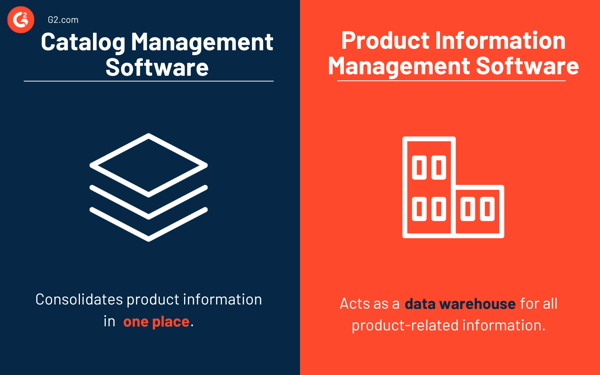
Catalog management software consolidates product information in one place and enriches product data by facilitating editing, adding, and modifying information.
Product information management software acts as a data warehouse for all product-related information. It is mostly used by the marketing and sales department to syndicate product data internally to automate workflows, close business deals, and drive campaigns.