

Outbound marketing is a strategy that promotes products or services by actively reaching out to potential customers through channels such as cold calls, email blasts, direct mail, TV ads, and paid search ads.
While often effective, outbound marketing can be expensive and perceived as intrusive or annoying by some consumers.
Businesses often use marketing automation software to plan campaigns, manage outreach lists, track leads, and measure performance metrics such as click-through rate (CTR), cost per lead (CPL), and return on investment (ROI).
Unlike inbound marketing, which attracts customers through content and organic discovery, outbound marketing proactively reaches leads through direct promotion. It uses channels like cold calls, email campaigns, paid ads, direct mail, and trade shows to quickly generate awareness and leads. While it offers fast visibility and broad reach, it often requires higher upfront investment, precise targeting, strong messaging, and performance tracking to maximize ROI.
Examples of outbound marketing include cold calling, email campaigns, paid advertising, direct mail, and trade shows. Companies often combine multiple outbound channels to expand reach and target specific audience segments.
Outbound marketing helps businesses quickly generate awareness, reach large audiences, and drive immediate leads or sales. By proactively promoting products or services across paid and direct channels, companies can influence buying decisions at scale and accelerate short-term results.
Outbound marketing challenges involve higher upfront costs and potentially lower engagement compared to intent-driven strategies. Since businesses initiate contact directly, campaigns may seem disruptive and are harder to measure offline.
Outbound marketing best practices center on precise targeting, clear value messaging, and ongoing performance measurement. To maximize ROI, businesses should define buyer personas, refine messaging, test campaigns, and track key performance indicators (KPIs).
Outbound marketing involves pushing promotional messages via direct outreach and paid channels, while inbound marketing attracts customers through valuable content and organic discovery. The key difference is who initiates the interaction.
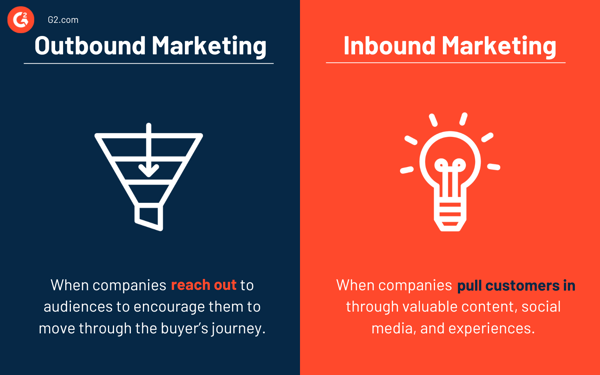
The table below highlights the main differences between outbound and inbound marketing strategies.
| Feature | Outbound marketing | Inbound marketing |
| Approach | Pushes messages to audiences | Attracts audiences through content |
| Initiation | Business initiates contact | Customer initiates engagement |
| Channels | Cold calls, paid ads, direct mail, and trade shows | Content marketing, search engine optimization (SEO), and social media |
| Speed of results | Often generates faster awareness and leads | Builds momentum over time |
| Cost structure | Higher upfront investment | Typically lower cost per lead over time |
| Goal | Immediate reach and short-term conversions | Long-term trust and sustainable growth |
Below are answers to common questions about outbound marketing.
Outbound marketing tools include marketing automation platforms, CRM systems, email outreach software, and paid advertising platforms. These tools help manage campaigns, segment audiences, and track performance and ROI.
Outbound marketing requires audience targeting, persuasive messaging, campaign management, and performance analysis. Marketers must understand paid platforms, outreach techniques, and metrics like CTR and cost per lead.
Google Ads is considered outbound marketing because businesses pay to promote messages to targeted audiences. Even when ads appear in search results, they are advertiser-initiated placements.
Learn more about KPIs and how they can be used to monitor the results of outbound marketing efforts.


What is B2C? B2C, sometimes referred to as BTOC, is a business model in which a company sells...
by Kelly Fiorini

What is brand recognition? Brand recognition refers to a company’s ability to be identified...
by Kelly Fiorini

What is white labeling? White labeling is when a company makes a product that another company...
by Kelly Fiorini