What is firewall management?
Firewall management is the process of setting up and monitoring a firewall on a private network, both in business and personal settings, to maintain network security.
Some companies may have multiple firewalls of various types configured on their networks. This makes firewall management an even more critical aspect of cybersecurity, as each must be set up and monitored carefully to provide maximum security.
IT teams typically use network security policy management (NSPM) software to ensure policy compliance and manage the firewalls under their control. These systems allow teams to enforce the policies company-wide and simplify security measures.
Types of firewalls
Businesses can use software or hardware firewalls or a combination of both when deciding on a firewall. These operate differently based on what they’re being used for. The most common types of firewalls are:
- Proxy firewalls: Acting as a go-between for the device and the network, these firewalls prevent a direct connection. This makes them one of the safest firewalls options; however, they can be slower than others. Many proxy firewalls are cloud-based.
- Circuit-level gateways: Like a proxy, these firewalls create virtual connections between the device and network while hiding the IP address of the device. Despite this, some malware can still bypass these systems, so they’re often used alongside other types of firewalls.
- Next-generation firewalls (NGFWs): These firewalls are considered the most sophisticated available, with the ability to filter traffic based on the applications they’re trying to access. Many also include anti-virus and malware protection built into the firewall, along with real-time threat monitoring.
Basic elements of firewall management
Regardless of the type of firewall being used, all effective firewall management must have several overlapping components to be effective.
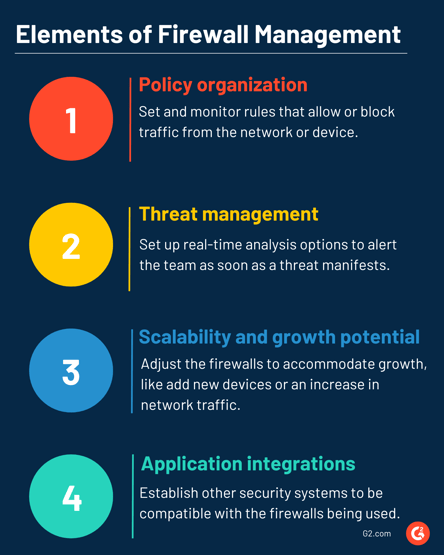
These are:
- Policy organization: A significant part of managing firewalls is setting and monitoring the rules that allow or block traffic from the network or device. Factors like IP addresses and protocols must be continually monitored for optimal configuration.
- Threat management: As the role of a firewall is to prevent malicious activity, monitoring for potential threats is critical. Many new firewall management systems have real-time analysis options to alert the team as soon as a threat manifests.
- Scalability and growth potential: When the business grows, so must the IT security systems in place. Effective firewall management means having the ability to adjust the firewalls within the company to accommodate this growth, like adding new devices or an increase in network traffic.
- Application integrations: Other security systems the company has should be compatible with the firewalls being used. Many firewall management systems allow these applications to be connected within a central system, making management easier and simpler.
Benefits of firewall management
Any firewall used should never be set up and left unmaintained, which is why firewall management is so important. Some of the benefits of regular management of firewalls are:
- Protection from hacking and malware: As viruses and malware become more sophisticated, firewalls must be updated to counter potential threats. With ongoing firewall management, businesses can improve cybersecurity protection and use the most up-to-date technology to prevent unauthorized users from accessing company data.
- Increased visibility on network traffic: Any data coming in or out of a system is an opportunity for someone to compromise the business’ data or devices. Firewall management systems give a real-time look at what traffic is using the network, where it’s coming from, and what is being accessed.
- Greater organization for system security: When several firewalls are being used across a system at one time, something can easily slip through the cracks. Firewall management gives IT teams the ability to organize and manage policies and rules across multiple firewalls at once while being able to track any changes or updates that are needed.
Firewall management best practices
An effective firewall management practice is essential for any business looking to improve their cybersecurity. Some of the best practices that should be considered when setting up and maintaining firewalls include:
- Blocking all access as a default setting: It’s much easier to add authorized access through a new rule than it is to block individual pieces of traffic to a network. Therefore, it’s best to remain cautious and block all traffic as a primary rule, then permit users as and when needed. This lowers the risk of unauthorized intrusions to networks and devices.
- Tracking authorized users: A list of authorized users should be maintained within the firewall management software, with ongoing monitoring of who logs into which applications and devices. Centralized user access control provides teams with a more robust and secure system.
- Conducting regular audits of rules: Removing old rules that are no longer relevant, along with any users who no longer need access to the system, means that teams can avoid potential exploitation of their firewalls. Conflicting rules can be particularly harmful, so routine audits of all rules in place should resolve any possible issues.
Keep your company’s network and devices protected from malicious threats with dedicated best firewall software.





 by Soundarya Jayaraman


 by Mara Calvello