What are cloud-native applications?
Cloud-native applications run on cloud architecture to efficiently offer agile computing resources. Organizations use them to cut costs and ensure high availability.
The term native application refers to software designed for specific platforms. Cloud-native applications use microservices to improve cloud performance. The microservice architecture allocates resources to each service that the application uses. It makes the application flexible and adaptable to the cloud architecture.
In the development cycle, software engineers look to cloud-native application protection platforms to simplify security and compliance management. These platforms help companies consolidate their security investment by bringing identity and access management (IAM), cloud security posture management (CSPM), and various other functionalities together.
Benefits of cloud-native applications
Cloud-native applications allow organizations to make the best use of their cloud environment. They easily adapt to the cloud’s dynamic architecture, offering many benefits to its users.
- Scalability. Teams can scale microservices independently as each microservice is logically isolated. Scaling one microservice won’t affect the others. It helps in situations where only a few of the components need to update faster.
- Cost-effectiveness. It becomes easy to scale computing and storage resources as per business requirements. This saves money because there’s no need for any extra hardware or load balancing.
- Portability. Cloud-native applications allow for porting microservices between various vendor infrastructures. These applications are vendor-neutral and prevent any kind of vendor lock-in.
- Visibility. Since microservices run independently, teams can study the application of each microservice and how they work together.
Key features of cloud-native applications
Below are some notable features that make cloud-native applications a developer's go-to choice.
- Containers. Cloud-native has container-based environments, which are the backbone of cloud applications. These apps are a group of independent services in the form of lightweight containers. They help deploy the applications without any hassle.
- Languages and frameworks. Cloud-native applications understand several languages. Developers can write user interfaces (UI) or application programming interfaces (API) with Node.js or Java. Some common frameworks available are MicroProfile, SpringBoot, and LoopBack.
- Microservices. In a microservice architecture, software applications build and design small, discrete pieces of code functionalities that work as loosely coupled services. Every service is independent of the others. Users can make updates as required.
- APIs. Microservices make use of fast, lightweight representational state transfer APIs to communicate. Cloud-native applications also use other APIs like middleware messaging systems.
- Architecture and platform. Cloud architecture and platforms help developers concentrate on applications’ functionalities. Developers don’t have to simultaneously manage the operation systems on which the application is running. Cloud architecture has both stateless and stateful services that are independent. Stateful service holds data in its memory, while stateless service does not store any session data in its persistent memory.
- Operating system. The containers in cloud-native services operate at a high abstraction level. They’re not biased to any particular operating system or specific machines. Unlike virtual machines, containers don’t require an operating system’s inclusion. When microservices need solid state drives (SSDs) or graphics processing units, another subset of machines makes it available.
- Elastic infrastructure. Applications can make the most out of cloud platforms that provide shared infrastructure virtually or elastically. It adds the flexibility of scaling up and down or expanding and shrinking resources per the application’s usage.
- Agile DevOps process. Each microservice in the cloud-native application has an independent life cycle managed through agile DevOps processes. These processes help implement the Agility Triad’s elements - speed, control, and flexibility.
- Automation. Automation is one of the major approaches that runs and scales applications in the cloud. It helps manage large and complex applications.
Cloud-native applications security
Cloud-native applications are prone to security risks, but there are measures for keeping these applications safe and secure.
- Apply security at a functional level. Implement perimeter security at the functional level to identify what gets triggered by different source types. Make sure the web API and application protection (WAAP) services are current.
- Roles for each function. Establish suitable and minimal roles for all the interactions between cloud-native resources.
- Ensure security is everyone’s responsibility. See that developers, DevOps, and AppSec teams align on security needs and requirements.
Cloud-native applications vs. cloud-enabled applications
Some may confuse cloud-native applications with cloud-enabled applications, but the two have key differences.
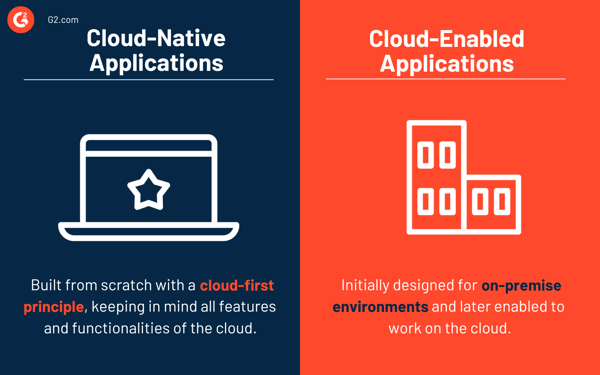
Cloud-native applications are built from scratch with a cloud-first principle, keeping in mind all features and functionalities of the cloud. They include technologies like microservices and containers. Following a distributed microservice architecture, they allow businesses to scale services independently.
Cloud-enabled applications were initially designed for on-premise environments and later enabled to work on the cloud. This often involves modifying a part of a software module to transfer applications to cloud servers.
A cloud-enabled application doesn’t have the flexibility or scalability options compared to cloud-native applications. The former follows a monolithic architecture, and these applications may not fully embrace the benefits of the cloud.
Learn more about cloud security monitoring and analytics software to monitor and protect cloud-based applications.